
What is actually inside the vents on your property.
Most of them are fine. That is exactly why the job is worth doing properly — because the handful that are not fine are the ones nobody can see.
By Noah Goodman, founder · Cleaning dryer vents since 2013
Here is the thing about a dryer vent community. In about three quarters of the units, the vents are a little linty. They need cleaning, sure. But they are not the reason we are there.
75%
Lightly linty
They need cleaning, and they are not the reason we are there. This is ordinary maintenance and it goes quickly.
1 in 5
A real amount of lint
Enough to start affecting how the dryer runs. Left alone through another year, a good share of these become the next category.
1 in 10
Packed solid
Compacted into something like a hockey puck sitting in the duct. These are the ones we came for.
So the whole job is really a search. We are sweeping a property to find the handful that are about to become somebody's problem. Everything else is maintenance.
That ratio is about people, not buildings.
A newer property does not get a better ratio. What drives it is how often that tenant does laundry, how hot and how long they run the dryer, how much they are washing, and how well the vent got cleaned the last time somebody was out.
One tenant does four loads a week. One does four loads a day. The vent tells you which is which — and it is the only thing that does, because nothing about the unit, the lease or the building age predicts it.
Which is why an annual sweep of the whole property is the only way to find them. You cannot target this. You can only look everywhere and find the ten percent.
What happens when the packed one is missed.
It is not dramatic. It is a slow sequence, and every step of it costs somebody money.
- 01
The dryer takes longer and longer to dry a load.
The moist air has nowhere to go, so the cycle stretches. Tenants run it twice.
- 02
It starts smelling funky.
Air that is not moving sits in the duct. That smell is the first thing a tenant actually complains about.
- 03
The steam comes back into the unit.
It has to go somewhere. It goes into the room and into the walls, and now you are having a mold conversation.
- 04
The heating element burns out early.
It is working against a wall of lint, every cycle, for months.
- 05
The tenant buys a dryer.
That is $500, maybe $1,500 — from a person who was current on rent last month.
Nobody puts that on a flyer, but it is the version I care about. This small piece of maintenance protects the tenant's ability to pay you.
And then there is the reason your insurer asks.
Past all of that, there is the reason the insurance company makes you do this annually. Compacted lint gets very hot with nowhere for the heat to go. It ignites.
That is the one everybody is trying to prevent, and it is the one nobody wants to talk about until it happens.
Whether you find it comes down to equipment.
Cleaning a vent is compressed air. So the real question is how much air you can deliver, and for how long.
A lot of outfits run a small compressor and a small tank, which gives the technician maybe 60 or 70 seconds of real cleaning power per vent. After that the compressor kicks on and they are working at a fraction of the pressure while it catches up.
What I watched in the field, back when I was consulting for other companies, was technicians who worked to that limit. Stick the hose in, use the thirty seconds, and whatever came out in thirty seconds is what the customer got. Then on to the next hole. If the puck did not move, the puck did not move.
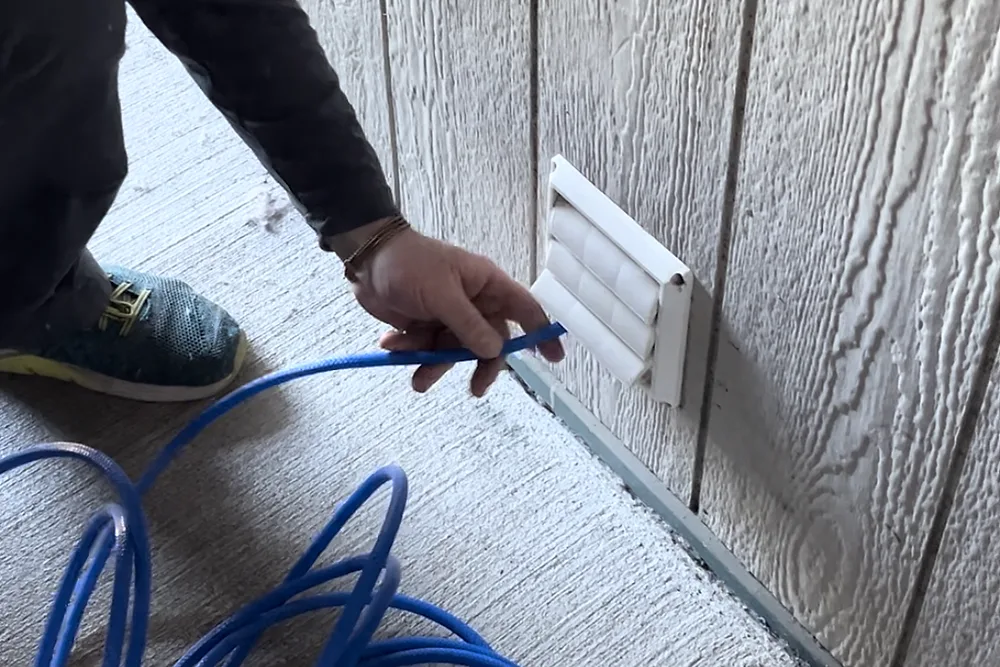
We run a bigger tank and a bigger motor so we can hold full pressure and full volume long enough to actually move everything out. That is it. That is the whole trick. It just means we are not on a clock inside each vent.
Better equipment is also faster, and faster is cheaper. We would rather pass that through than pocket it — which is part of why apartments typically land at $10 to $24 a vent rather than the $150 quotes that float around this trade.
What I know is what is in the ten percent. Somebody's vent on your property is packed solid right now, and they do not know it, and neither do you.
We are pretty good at finding that one.
Find the ten percent.
Same-day estimate by phone. Tell us the address and the vent count.
(971) 777-3813